Contact Us
- Address: Réservations par internet seulement
- Email: infoSPAMFILTER@spaceobs.com
- Phone: No telephone
- Cellphone: No telephone
- Website: www.spaceobs.com
Next moons
11-09-2026 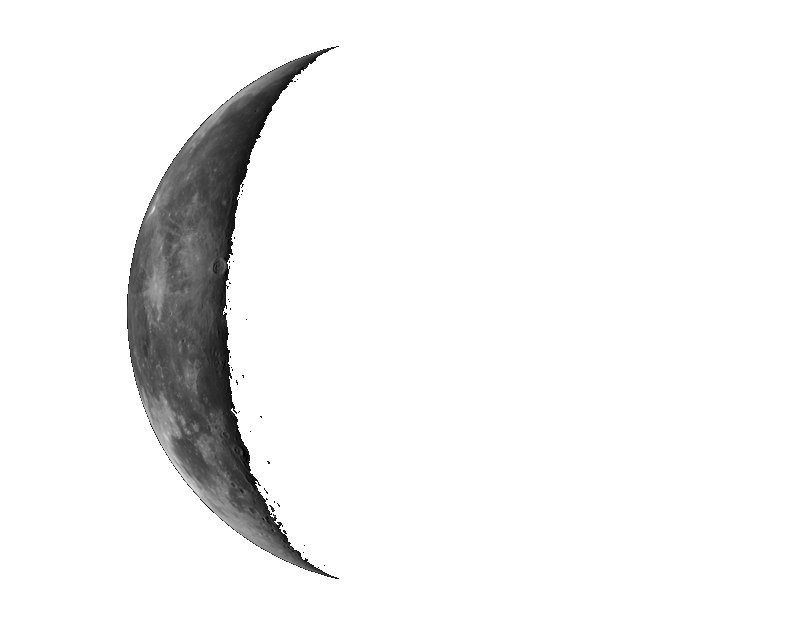 | 18-09-2026 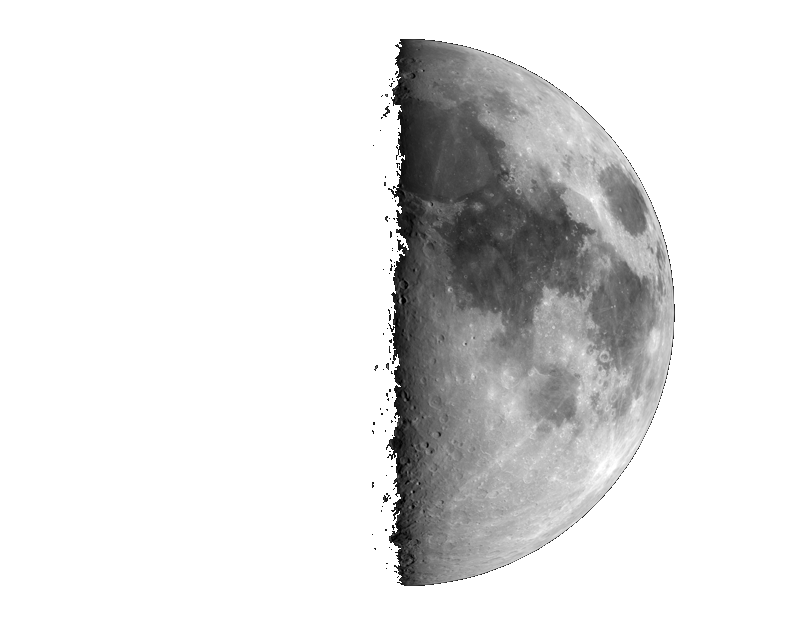 |
26-09-2026 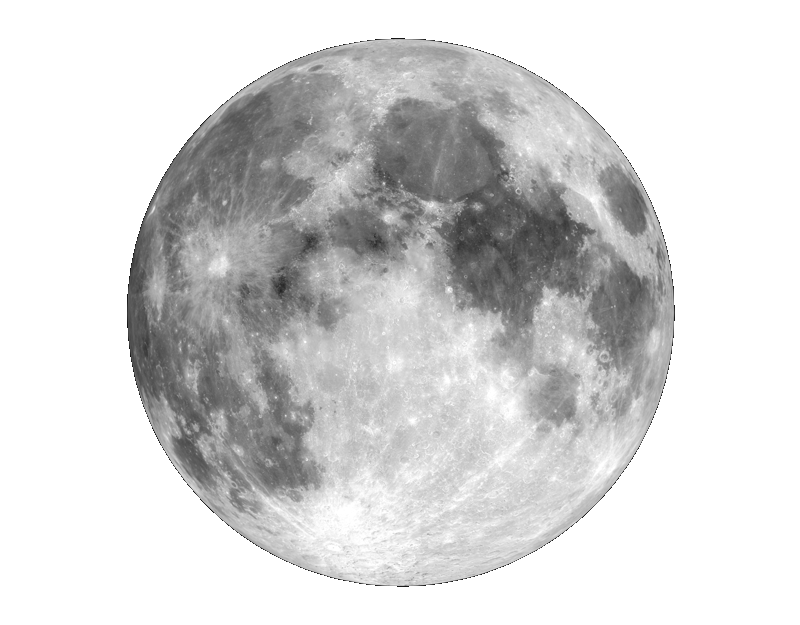 | 03-10-2026 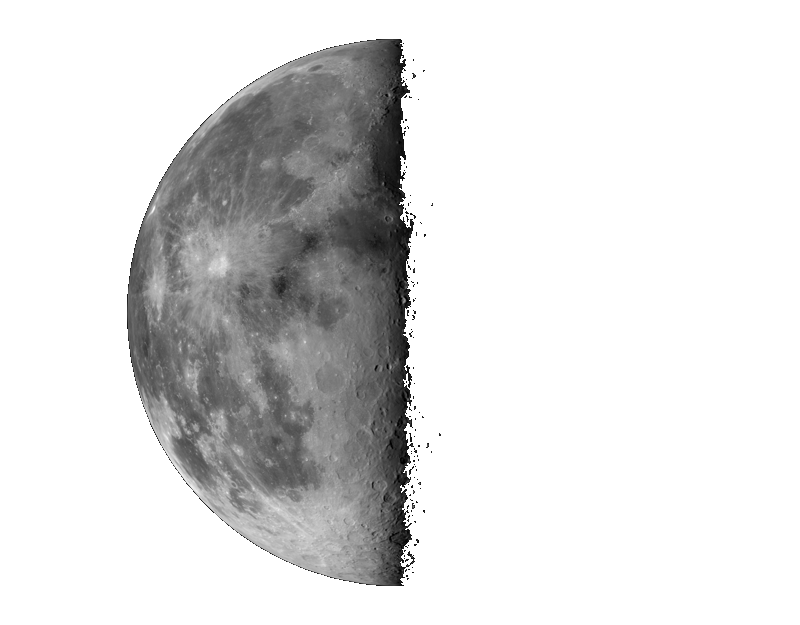 |
Sponsors





Alain Maury – March 2026
Long gone is the time when amateur astronomers could discover a comet visually with a small instrument. We are in the era of large professional digital sky surveys and it gets more and more difficult to find comets since most of them are discovered when far away from the sun, faint, by larger telescopes.
Executive résumé
- Discovering comets and asteroids is a mix of instrumentation, software, luck and perseverance.
- Today apart for very lucky people, one need an efficient instrumentation and software
- Due to the current definition of “discovery” from the minor planet center, it’s almost impossible for an amateur astronomer to discover an asteroid since there is always a much larger professional instrument having earlier observation
- Nevertheless, the maps project shows that it’s, under certain condition, possible to be quite competitive in this field as amateurs
- Amateur discoverers of comets used to receive the Edgar Wilson award, but since 2019, the director of the Harvard Center of Astrophysics is using the funds received from the Edgar Wilson for other purposes and there is in practice no more Edgar Wilson award. Amateur comet discoverers for a given year were sharing a some of about 20000US$.
Glossary:
NEA or NEO : Near Earth Asteroid or Near Earth Object
MPC : Minor Planet Center
NEOCP : Near Earth Object Confirmation Page
MPEC : Minor Planet Electronic Circular
ITF : Isolated Tracklet File
PCCP : Possible Comet Confirmation Page
NASA : National Aeronautics and Space Administration
LSST : Large Synodic Survey Telescope
First, why would you want to discover an asteroid or a comet ?
Talk to anybody in this activity, they will tell you it’s great fun, lots of adrenaline when you discover something. It’s much more satisfying than taking long hours of exposures, and dozens of hours of processing hours on useless color pictures.
Second point, it’s a scientific project. If the US congress and NASA finance the asteroid surveys, it’s because it’s important to do an inventory of the potentially hazardous asteroids to make sure that none of them present a danger to the Earth. The truth is that it’s very unlikely there is any danger in the coming century, but it’s good to know.
This way we also discover various interesting objects in our solar system.
Then, in a more “funny” or anecdotic part: The possibility to eventually name objects in the solar system. Comets are usually named after their discoverer. Asteroids can be in theory named by the discoverer, once the orbit is precise enough and the object gets numbered by the Minor Planet Center. There are various rules. Near Earth Objects must in theory have the name of a divinity. Luckily humans have been very imaginative to create thousands of gods. The discoverer can not name an asteroid for a political or military person or for commercial purposes, etc…
In practice the definition of discovery has evolved with time. When the observations were made on photographic plates, measuring the position of an asteroid was quite a lengthy process, and many astronomers were sending positions of asteroids on a single night, and very often the precision of the measurements were not of very high accuracy. The then MPC modified its definition of discovery so that the discoverer was the first person who produced enough measurements to be able to compute some useful orbital elements. In practice it meant providing at least 2 nights of observations. Then more recently (2011 I believe) the MPC changed again the definition so that the discoverer was the first person providing astrometric position of an object during that opposition. This had two effects: First the discoverers were simply the person having the largest telescope, able to discover the objects when they were faint, even it would not provide a useful orbital solution. Said otherwise, a person or a group can become discoverer without realizing it has discovered a Near Earth Object or a comet.
The second effect is that it became basically impossible for an amateur to “discover” and therefore name a main belt asteroid, since the new rule clearly advantages the large telescopes with large detectors. After this change, a large number of amateur astronomers stopped observing asteroids.
This definition is of course quite unfair. At MAPS we have had a few cases where we discovered a near earth object, confirmed it, sent everything to the MPC which published it on the NEOCP. We realized it was a near earth object, and therefore had it published. Thanks to our work, many other observers followed it, and the object was published in a MPEC. But… Another group had observed a single night on the same object a few weeks before, sent it to the MPC which placed it in the ITF without realizing the real nature of the asteroid, and they became the discoverers.
Following the same rule, Hipparcos should be the discoverer of Uranus in 128 BC. He placed it in his star atlas, he plotted a very faint star, which actually was Uranus, but didn’t realize the real nature of the object, and that position, the earliest recorded position of Uranus, was used in order to compute the orbit of Uranus. Same thing with Galileo and Neptune. Galileo observed Neptune on December 28th 1612 and January 28th 1613, but he didn’t realize that it was a planet but since the current definition of discovery doesn't imply the discoverer to recognize the nature of the object he should according to the MPC be the official discoverer.
A logical definition should be that the discoverer of an object is the first person who publishes it on the NEOCP, or PCCP realizing this asteroid is a Near Earth Object or a comet. The objects reported in the ITF, meaning whomever sent it there didn’t realize the nature of the object should only be considered as a precovery, not a discovery.
In the era of LSST, if that telescope ever reports all its double points on the ITF, since they go a good magnitude further away than Panstarrs and Catalina, and all other observers, they will become discoverers of everything, and all the other groups will be observing just for them. The same rule which advantaged the current big surveys will now be applied to them since there will be a bigger survey.
By the way, what is an amateur astronomer?
There are maybe various definition and understanding of what is an amateur. It can be a person who has some interest in astronomy, and will keep informed through magazines or social media. It can be a person who has a small instrument and like to observe the moon and planets from his/her backyard. It can be somebody who has an expensive instrument used to make color pictures of nebulae.
It can also be a person who participates in science programs, in collaboration or not with professional astronomers.
For some professional astronomers, amateur has some kind of pejorative connotation, since they can’t be as good as professional, and are at best tinkerers producing no useful science.
Astronomy is one of the rare scientific fields where amateurs can produce interesting results. Few amateurs own their own particle accelerators, but many have telescopes.
As far as near earth objects, there is a worldwide community of people following up discoveries and the field would not be as successful if they would not be there.
In our case (the maps project), we have developed professional quality software which has allowed to discover more asteroids than many professional programs. Moreover, we work in the southern hemisphere where for now there is only one professional survey (ATLAS). And it’s not a really big surprise, since while amateurs, the members of the team are mostly professional computer programmers.
In my personal case, I used to work as an engineer in professional observatories, but have worked a lot on asteroids and comets (I discovered my first near earth object in 1983 and my first comet in 1985). I am a member of the International Astronomical Union, but left the professional world in 2003 in order to open my own public observatory in the Atacama desert. It was relatively hard at the beginning, but today, while "amateur" my salary today is about 3 times what it could have been if I had stayed working in the professional observatories, and becoming an amateur didn't mean I lost my competences
Here is for example the number of NEOs discovered in 2025 by our program (using 4 RASA telescopes) compared to a professional program observing from the Canary islands, member of the ATLAS group, using 16 RASA telescopes :
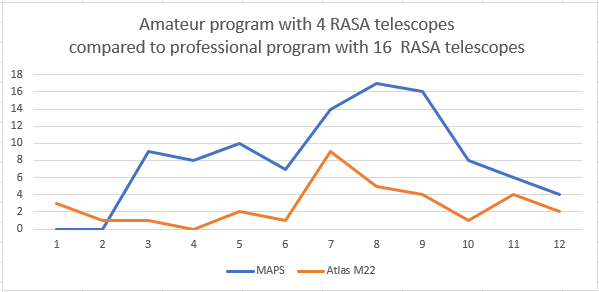
Not too “amateurish” .
Here is for example our results during 2025 compared to the sum of all 5 sites from Atlas and the JPL group also using synthetic tracking :
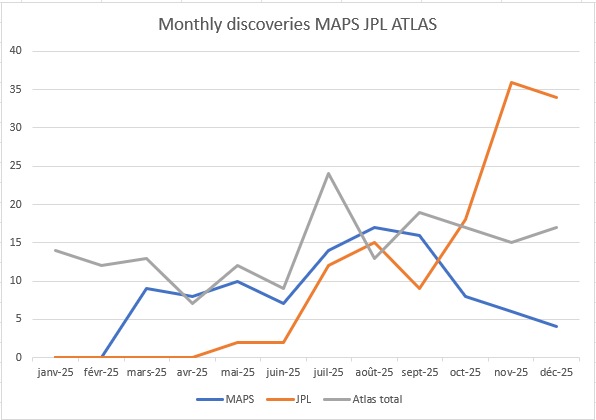
The JPL group also uses 4 RASA telescopes, but has more computing power than us, so they use much shorter individual integration time and are able to detect much faster asteroids. They therefore use a much shorter individual integration time and are able to detect much faster asteroids. This is certainly the solution to continue to discover objects if the LSST starts observing and reporting its observations in real time.
The current situation
The last visual discovery of a comet was by the late Don Machholz for C/2018 V1. During his life he spent a total of 9000 observing hours to discover 12 comets, or an average of 750 hours of visual observations in the cold per comet discovery.
The last photographic discovery of a comet was maybe comet Shoemaker Levy 9 in 1993.
Today’s discoveries, except a few cases, mostly by spacecraft looking the sun’s corona, are discovered well above magnitude 18.
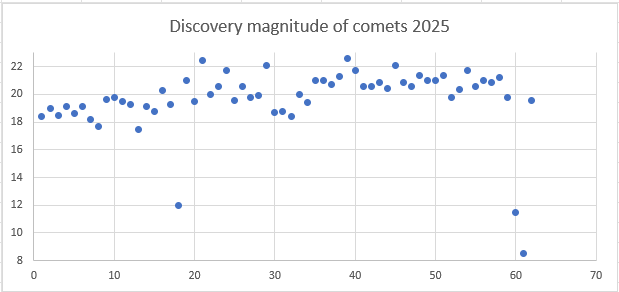
The first magnitude 12 comet of this diagram is a discovery by Crimean amateur Gennady Borisov, the other two on the right of the diagram have been discovered by the SWAN spacecraft in the vicinity of the sun. All the other discoveries, including by amateurs are magnitude 18 to 22.5.
In 2025, of 62 comets and A/comets (object having a cometary orbit but no cometary features), 24 have been discovered by the Panstarrs program, 15 by the Atlas program, 10 by the Catalina telescopes, and only 5 (8%) have been discovered by amateurs (3 by Gennady Borisov and 2 by our own program MAPS).
The probability of discovering a new comet is a mix of luck, area of sky covered and limiting magnitude. The problem is if you have a powerful telescope with a small field of view, a site which is not optimal you will need a lot of luck, or a lot of time (many years?) to be the first to see something. You can optimize by searching zones of small solar elongation where the surveys do not go usually (Palomar does I believe).
I didn’t do a similar statistic on near earth asteroids, 64 comets discovered last year, more than 3000 NEAs but the idea is the same, if you want to have a chance to discover something, you need to go close to magnitude 20.
To give an example, here is the part of the sky covered by current surveys (Panstarrs and Atlas apparently do not report their sky coverage to the MPC)
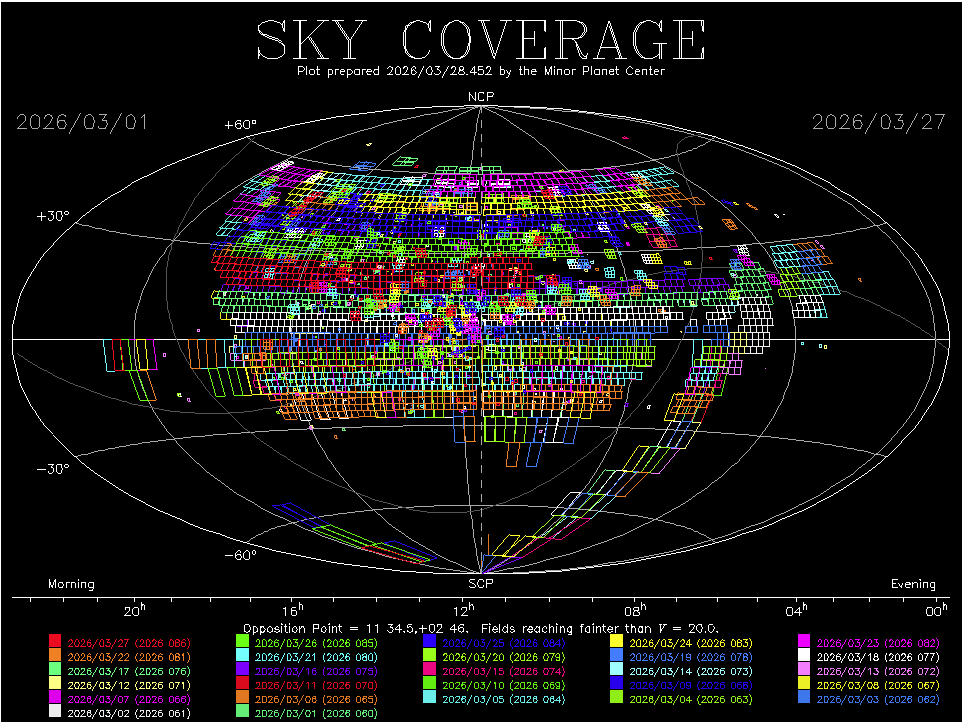
The elongated rectangles in the south are the field covered by maps in our comet mode.
What equipment to use to optimize the chance of discovering a comet or a yet undiscovered asteroid?
If you are a very skilled amateur, you can do like Gennady Borisov and design, build and assemble a large wide field telescope. If you want the same instrument, and if you are very rich, you can also have it built for you (they are not “off the shelf” products), the price will be in the 200000USD.
Except in rare occasion and on very good sites, the seeing can be below 1 arc second, then it can be useful to have a sampling of 0.5” per pixel (with an optical system, mount, tracking, etc… able to give 1 arc second images, 2 pixels wide). With today’s cameras, it means an instrument of about 1500mm of focal length. For most other places, with typical seeing of 2 arc second a focal length around 750mm is sufficient.
For programs that aim to cover a very large field, a parameter called the system extent is frequently used. As a first approximation, it is the collecting surface of the telescope multiplied by the number of square degrees covered by the telescope+detector. Let's say you're not immensely wealthy and settle for a full-frame camera, like the QHY600 or ZWO6200.
Comparison of some systems readily available to the amateur (without taking too much into account the central obstruction of either the camera or the secondary mirror):
RASA 11: 0.28x0.28x2.2x3.3=0.57
RASA 36: 0.36x0.36x1.737x2.6=0.585
4 RASA 11:2.28
8 RASA 11 : 4.56 :)
T40cm F/3:0.4x0.4x1.14x1.71=0.312
T60cm F/3:0.6x0.6x0.76x1.14=0.312
From this quick calculation, we can deduce that we gain practically nothing by switching from the RASA36 (a weirdness of Celestron, the RASA 11 measures 11 inches in diameter, 28cm, and the higher model is expressed in cm and measures 36cm), and given the price difference (RASA11 3700 euros, and RASA36 17500) it is better to buy 3 RASA11 and 3 cameras than a single RASA36 and a camera). We also see that Newton-type telescopes, even with a 4-inch Wynne corrector, necessary to cover the detector's field of view, are not at all competitive. I didn't take into account the RASA8 which only covers 22mm of field.
Turns out that today the best current compromise is indeed the Celestron RASA astrographs. They are relatively economical. As far as cameras, the full frame CMOS cameras by ZWO, QHY are apparently also quite well adapted, and offer the most “bang for the buck” (Moravian also offer full frame CMOS cameras but they are too bulky to be put in front of a RASA telescope).
It is highly recommended not to use a german equatorial mount, since they don’t allow to scan continuously the part of the sky close to the meridian without having to lose a lot of time doing meridian flips.
If you have no job and no family, you can start observing completely manually, getting the telescope out of your house, connect everything, make the polar alignment, focus the telescope, pointing the telescope where you want, making sure it’s there (plate solve a short exposure), do the exposure(s), preprocess them, blink several images in order to detect any moving object.
You will have to be very passionate to do that for several months, let alone years. So the correct way to do it is to automatize the observations so that every clear night the telescope observes alone without human intervention with a fixed installation.
There are several software out there able to do that, it’s everybody’s choice. In our case, we used the prism software which has a scripting feature which allowed us to do all of this easily. So each night, when the sun is below 5 degrees, the acquisition PCs and cameras are turned on, domes are opened, cameras are cooled. When the sun is at -15 degrees, the software starts the observations alone, knowing how to select each field. Our criteria are that we avoid the milky way, we don’t shoot any closer than 40 degrees from the moon in case there is the moon in the sky, and we don’t take fields which we already have taken in the past 5 nights.
We use the excellent Tycho Tracker software to reduce data, meaning we use the synthetic tracking technique, making many relatively short exposures, from which Tycho Tracker can detect automatically every moving object. Today this software is the de facto standard in this domain. In our case we do 36 exposures of 30 seconds on each field. While an exposure is done (i.e. during 30 seconds) the previous image is preprocessed (dark, flat), binned by a factor of 2, we take a window in the center of the image on which we do some astrometry and use it to recenter the image compared to the first image of the field, then send both images to a larger PC with a GPU board and will be able to reduce the data quickly. A single image is 120 Mb, so 36 of them is 4.3 Gb, we make up to 20 fields per night, so the raw data is about 780 Gb per night.
The script is a little bit more complex than what I describe here since in our case we have to synchronize 4 cameras (one master and three slaves), but with one camera it’s easy to do.
On this PC we have a windows script which checks the directory where the images are arriving. When the 36 images are there, Tycho Tracker is launched.
We adjusted everything so that the reduction time for 2 cameras can be done in less time than it takes to make a new series of exposures in order to be in almost real time.
Then Tycho detect several types of objects: Already known asteroids (present in the 1.5+ million orbits in the mpcorb.dat file), and unknown objects which can be in 4 distinct categories:
Typically, we will have about a hundred of these unknown detections per night, with only one to five real detections of new earth crossing asteroids. Many nights also with no useful detection at all.
This confirmation procedure is very important in order not to send false detections to the MPC. First because it’s a matter of seriousness. Second, it’s a waste of time for the people who all over the world do follow these objects in order to improve the quality of the orbits, and, correctly so, don’t like to lose time on fake detections.
An important point is that to submit observations to the MPC you need an observatory code. See https://minorplanetcenter.net/new_obscode_request
How to make the difference between a comet and an asteroid?
Start observing known comets of various magnitudes in order to get a feeling of what a comet, mainly when it’s faint, looks like, it’s always good experience.
Use also your telescope to shoot bright stars, or the vicinity of bright stars to make sure that you don’t confuse a reflection inside your telescope with a comet…
If you are able to run your own survey (you alone or you with a small group of friends), you will stumble upon already known comets.
Our rule of thumb is that you need to detect forty new Near Earth Asteroids before finding one new comet. Gennady Borisov is doing a lot better. In 2025 he reported 12 new near earth asteroids, and 3 comets. So by searching specific zones in the sky one can maximize the probability of discovering a comet.
Some comets clearly have a “halo” or even a “tail” around them. Some are just barely larger than similar stars in the field. In the case where we have a doubt, we compare the image of the candidate with a star of similar brightness on a non tracked (round stellar images) image of the same field. Tycho Tracker allows to measure the FWHM of the image (the “width” of the image) to see if they are similar or if the “candidate” is indeed slightly larger.
Then we use the software findorb, mainly if we have also obtained a confirmation image a while later in order to compute the orbital elements. Most asteroids have a low inclination (less than 30 degrees), and comets can have inclination higher than 90 degrees. There are very few asteroids with such inclination. So sometimes in case where the object is faint, the fact that findorb gives you a high inclination can help you to decide that your detection is a real comet.
You can then send your astrometry to the MPC.
Then you have to fill out a cometary activity report (https://minorplanetcenter.net/mpcops/submissions/cometary/) then also send an email to Dan Green at the Central Bureau of Astronomical Telegrams (dangreen cbatiau0@gmail.com) in order to announce your discovery and give information about the nature of the object.
Then your comet, if identified as a new comet, will be moved from the NEOCP to the PCCP (Possible Comet Confirmation Page) and might indeed be a new comet. If many other observers fail to see your object, it’s likely you made a mistake.
How much does it cost?
There are many hobbies which are quite inexpensive, and some which are much more expensive than comet and asteroid hunting. Football (a game with a ball, played with the feet only, that’s why it’s called football, and I don’t know why called soccer in the USA, since the US football is played with a ball which is not a ball and with the hands) is very inexpensive, mostly since one needs only one soccer ball for 22 players. It can be played without having a stadium, that’s how it’s played in most countries. Yachting, or airplanes on the other hand are very expensive. Asteroid hunting is somewhere in between.
Let’s make a short list :
An enclosure for the telescope, can be made with a modified garden shed, 1K$ up to purchasing a clamshell dome (25 K$)
A good equatorial mount, between 5K$ to 30K$
A RASA telescope with focusing motor and camera adapters, 4.5 K$
A CMOS full frame camera : 4K$
A small PC to control the mount, take images, etc… 1K$
A larger desktop PC with a GPU board, anywhere from 3 to 6 K$
Some software to automatize the observations and tycho tracker (inexpensive), less than 300$
Maybe if your house is not in the darkest sky, send your equipment to some telescope hosting facility, which can be from 5 to 12k$ per year. Then add shipping, insurance, sometimes installation costs, etc…
Development of all the software required. In our case it took 2 good years, and we are still improving things all the time. Hard to put a price on this, but clearly it helps if you know how to program a personal computer. If you were to pay this development in the industry, it would likely be the most expensive item of all.
All and all, unless you count on your luck to discover a comet with a pair of binoculars, comet hunting has become quite expensive compared to what it was 20-30 years ago when CCD cameras and computers became available.
How to finance your project?
If you are somewhat rich and dedicated, you can finance with your own money. That's what I did, over a period of several years.
There might be other ways, maybe find a sponsor, but usually it’s better when you have already proven you can do some serious job and achieved some useful results. You need to show some credibility.
Once you have published already many good quality observations, there are two ways to obtain financing to improve your program.
One is the Planetary Society Eugene Shoemaker NEO grants https://www.planetary.org/sci-tech/neo-grants It won’t cover all your fees but are really helpful. In our case it was decisive in order to put 4 more RASA telescopes in action. Comet C/2026 A1 Maps would not have been discovered without the help of the Planetary Society which financed the camera with which the comet was discovered.
The second which is not working anymore was the Edgar Wilson Awards which consisted of a sum (about 20K$) divided equally between all the amateurs who had discovered a comet in the past year. The Edgar Wilson Charity fund pays between 36 to 40 K$ per fiscal year to the Smithsonian Astrophysical Observatory (SAO), which send distributed 20 K$ of that sum to the amateurs. But since 2019, the SAO director decided he had better use of the money and since then the Awards were announced but no money was sent. The SAO, through the MPC was supposed to send an commemorative plaque to the discoverer, and meant, but never did, to organize seminars for amateur astronomers in order to explain to people who already know how to discover comets how they could discover comets (see https://www.minorplanetcenter.net/mpcops/documentation/edgar-wilson-award-information/ and https://www.minorplanetcenter.net/mpcops/documentation/edgar-wilson-award-winners/ ). This is a clear case of charity fund misappropriation, which we are currently trying to resolve with the SAO.
With 8 comets discovered during the maps program, we should have received more than 50 K$ of funds which would have allowed us to really improve our survey system.
11-09-2026 | 18-09-2026 |
26-09-2026 | 03-10-2026 |